AeroDock — aerial patrols with no pilot on site
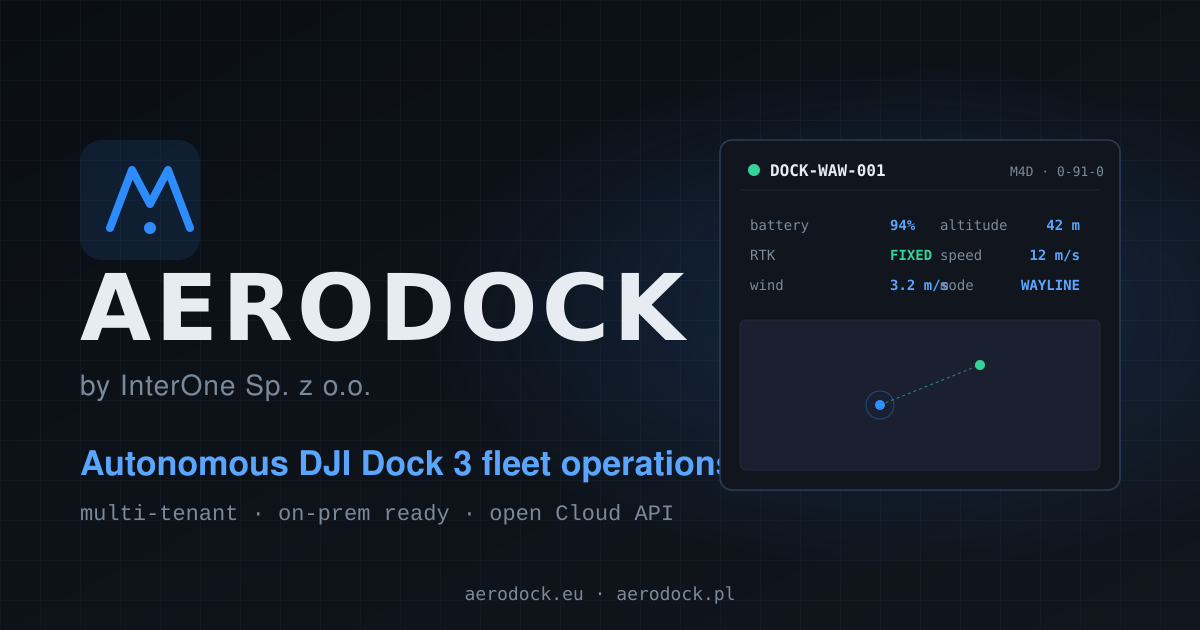
SKADAR detects other people's drones. AeroDock is the flip side of the same coin — it flies your own, autonomously, straight from a hangar in the field. The drone launches itself on an alarm, streams live to the dispatcher's browser and returns to the dock to recharge. With no pilot standing in a field.
A drone that lives in a hangar
A classic drone flight needs a human on site: someone has to drive over, unpack the kit, take off, land, pack up. AeroDock removes that requirement. The drone lives in an automated hangar (DJI Dock 3), sealed and weatherproof, ready around the clock. On a signal the roof opens, the aircraft launches in about 30 seconds, does the job and returns on its own — lands, charges the battery and waits for the next call. Nobody is standing at the launch point.
From alarm to response — four steps
The point of the system is clearest on a night shift at a guarded site. The dispatcher never leaves the control room:
- Trigger — the alarm panel detects a perimeter breach and the signal reaches AeroDock automatically, straight from the intrusion system or the control room
- Auto-launch — the system picks the nearest free dock, opens the hangar, factors in the current airspace zones and sends the drone along a defined route to the incident point
- Live picture — the dispatcher sees the camera stream, a map with the position and telemetry in the browser; one click takes control or redirects the aircraft
- Return & archive — after observation the drone returns to the hangar and recharges, and the full footage with metadata lands in the archive per the retention policy
Everything in the browser
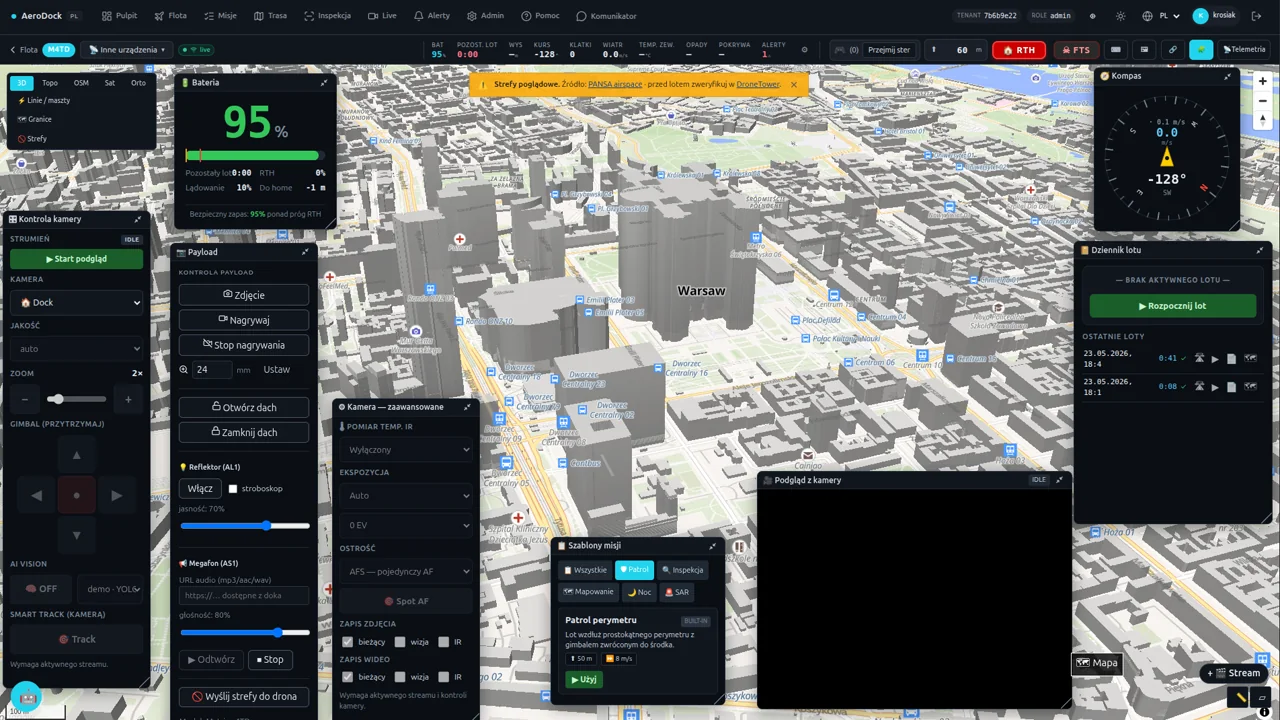
There is no app to install. The dispatcher works in a browser window: a map with every drone and hangar, telemetry, battery state and charging, device-health alerts. The camera feed streams live to many watchers at once, recorded with time and position stamps — ready as evidence. When needed the dispatcher takes control from the browser, emergency stop included; optionally they can pair an ordinary game controller over Bluetooth.
Routes are planned by clicking points on a 3D map with buildings. Before a mission goes airborne, the system checks it for collisions — with buildings, high-voltage lines and towers (pylon height estimated from the line voltage) and for breaches of controlled airport zones. Ready-made mission templates — perimeter patrol, orbit around a point, linear inspection, mapping run — launch on a schedule.
An artificial eye
The picture is one thing; AeroDock can also watch for the dispatcher. Real-time analysis detects people, vehicles and animals in the drone feed — object boxes overlaid live, around 30 milliseconds per frame. Four modes: preview, security with an automatic alarm, object counting and anomaly detection. It turns „someone has to watch ten screens at once” into „the system raises an alert when there is something to look at.”
Where it flies
AeroDock replaces the walking patrol wherever an area is larger than a fixed camera reaches and smaller than a helicopter can justify:
- Site security — night patrols, alarm response from the control room, visual verification of fixed-camera events
- Critical infrastructure — inspections of transmission lines, pipelines, tracks and water intakes; scheduled flights documenting state and alarm-driven response to faults
- Industry & logistics — stockpile inventory, perimeter control, monitoring of restricted zones without halting production
- Public sector — crowd monitoring, support for emergency services, border observation; flight footage ready as evidence
Three models, your data stays put
The same console and the same features can run three ways, depending on the customer's security policy: in a Polish cloud run by the team, as a turn-key appliance installed on-site (works with no internet uplink — the pick of defence and critical-infrastructure sites), or fully inside the customer's own data centre. In every variant the footage and the event log stay where they are meant to. That is not a slogan — for the kinds of sites in question, data sovereignty is often a precondition for the conversation.
Why this belongs on my blog
Because it is amateur radio in disguise, again. Underneath, AeroDock is telemetry, radio links, a picture off the air and a dispatcher console — and that console even has classic PTT: to speak to another dispatcher you hold a key, talk, release, exactly like on a radio. The same comms discipline I have been practising on TETRA for years sits right inside it. And it closes nicely with SKADAR: one system flies its own drones, the other detects other people's — two sides of the same sky, both developed by the SP8MB team within InterOne, entirely in Poland.