SwMI dla stacji Motorola
A homebrew core for professional EBTS, MBTS and MTS base stations
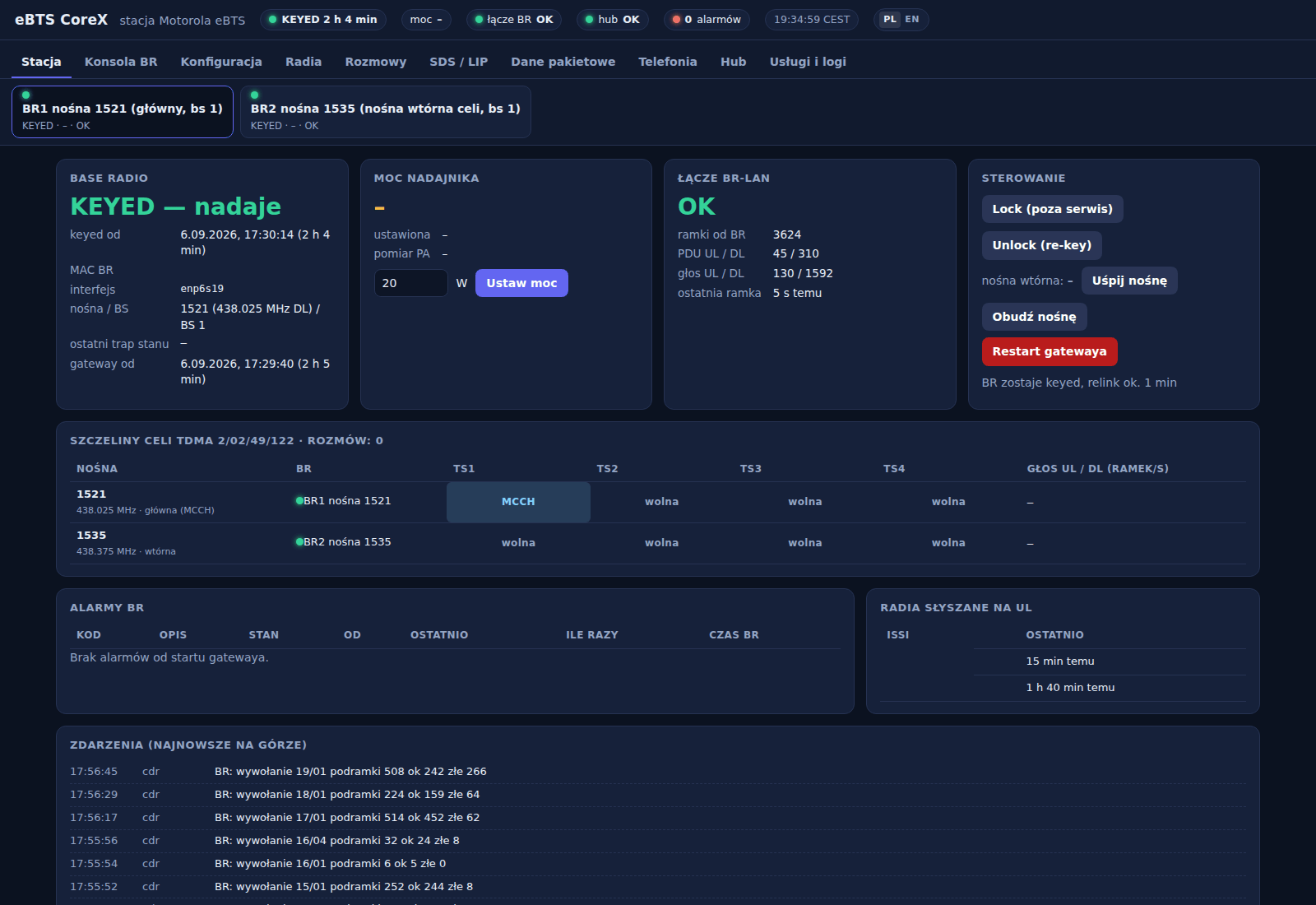
Professional Motorola EBTS, MBTS and MTS base stations without the vendor’s core. The station’s BR (Base Radio) works for us with the TSC (Site Controller) eliminated: homebrew software talks straight to it, brings it up and carries all the traffic — and the station works in the TetraPoland network with the whole package that comes with it. On a real EBTS station since September 2026, with the original controller disconnected and two Base Radios as one two-carrier cell.
What it does
- The BR (Base Radio) works for us with the TSC (Site Controller) eliminated — in EBTS, MBTS and MTS stations
- Transmitter bring-up, keying and supervision with no operator
- Two carriers in one cell — two Base Radios under one controller
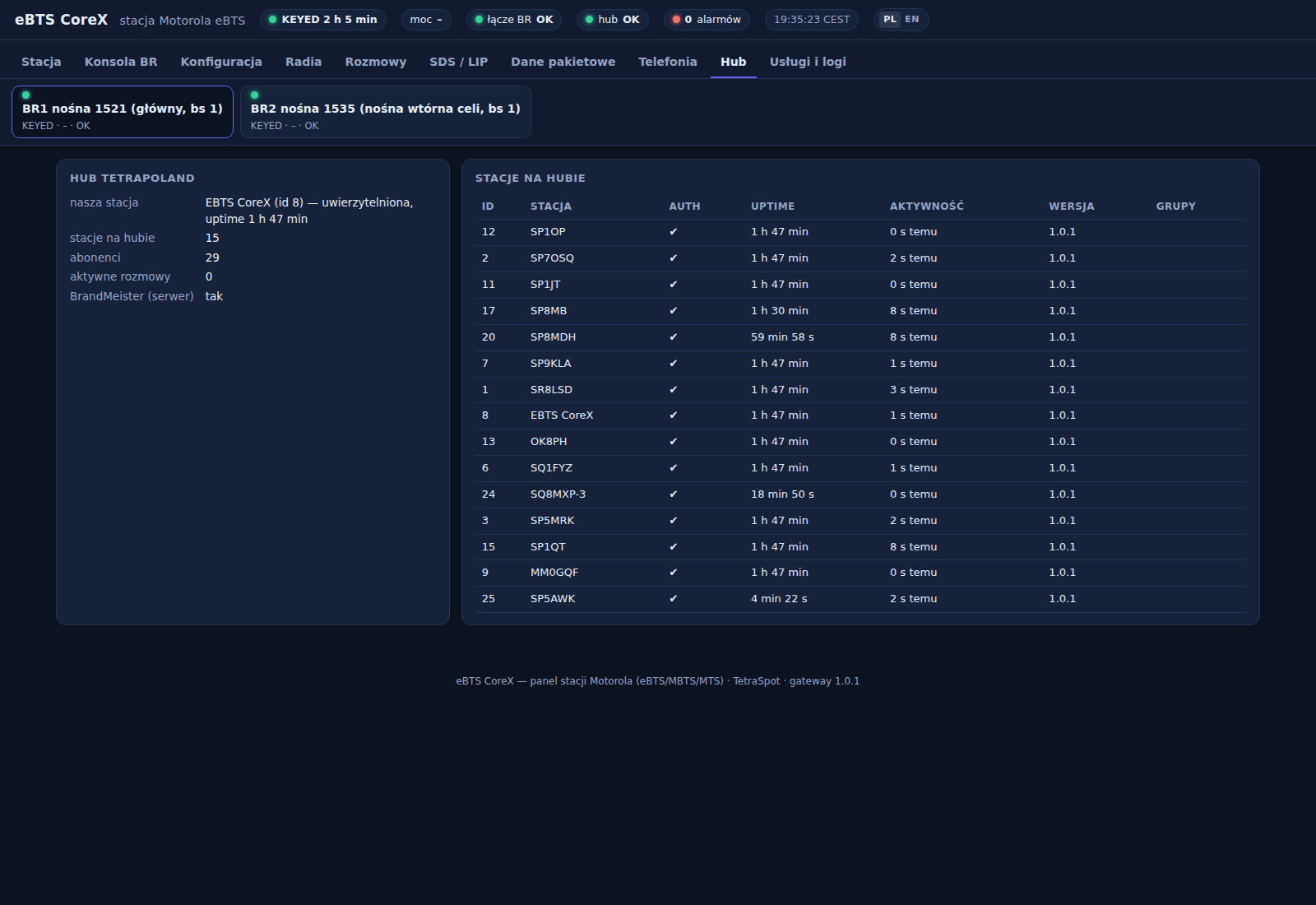
- Works in the TetraPoland network with the whole package that comes with it — group and individual calls, locally and network-wide, calls out to a phone
- Radio positions and the station panel in a browser
- The same stack that drives TetraSpot
The Motorola EBTS, MBTS and MTS are professional TETRA base stations. They do not transmit on their own — they need the Dimetra core network (the SwMI) that brings them up, configures them and runs every call. Without that core they are transmitters with no brain. This project replaces the core and covers all three station families. The station’s BR (Base Radio) now works for us with the TSC (Site Controller) eliminated: a homebrew controller talks to it in its own protocol and hands all the traffic to the same stack that drives TetraSpot. A professional station becomes a full node of the TetraPoland network — no vendor core, no vendor servers, no dependence on anyone else’s infrastructure. Since 5 September 2026 the controller has been running two Base Radios as one cell with two carriers.
What works on a real station
- BR configuration and keying just like the original TSC, TETRA time synchronisation included
- Adoption of a running BR after the TSC (Site Controller) is unplugged — no station restart
- Two carriers in one cell — two Base Radios under one controller, the second as the secondary carrier with four traffic channels; sleep and wake of the secondary carrier from the panel
- Radio registration, groups, group calls locally and through the TetraPoland hub with voice both ways, PTT again during the call hang time
- Individual calls, simplex and duplex — talker change and voice in both directions at once
- A call from a radio to a telephone number through the SIP gateway, with audio
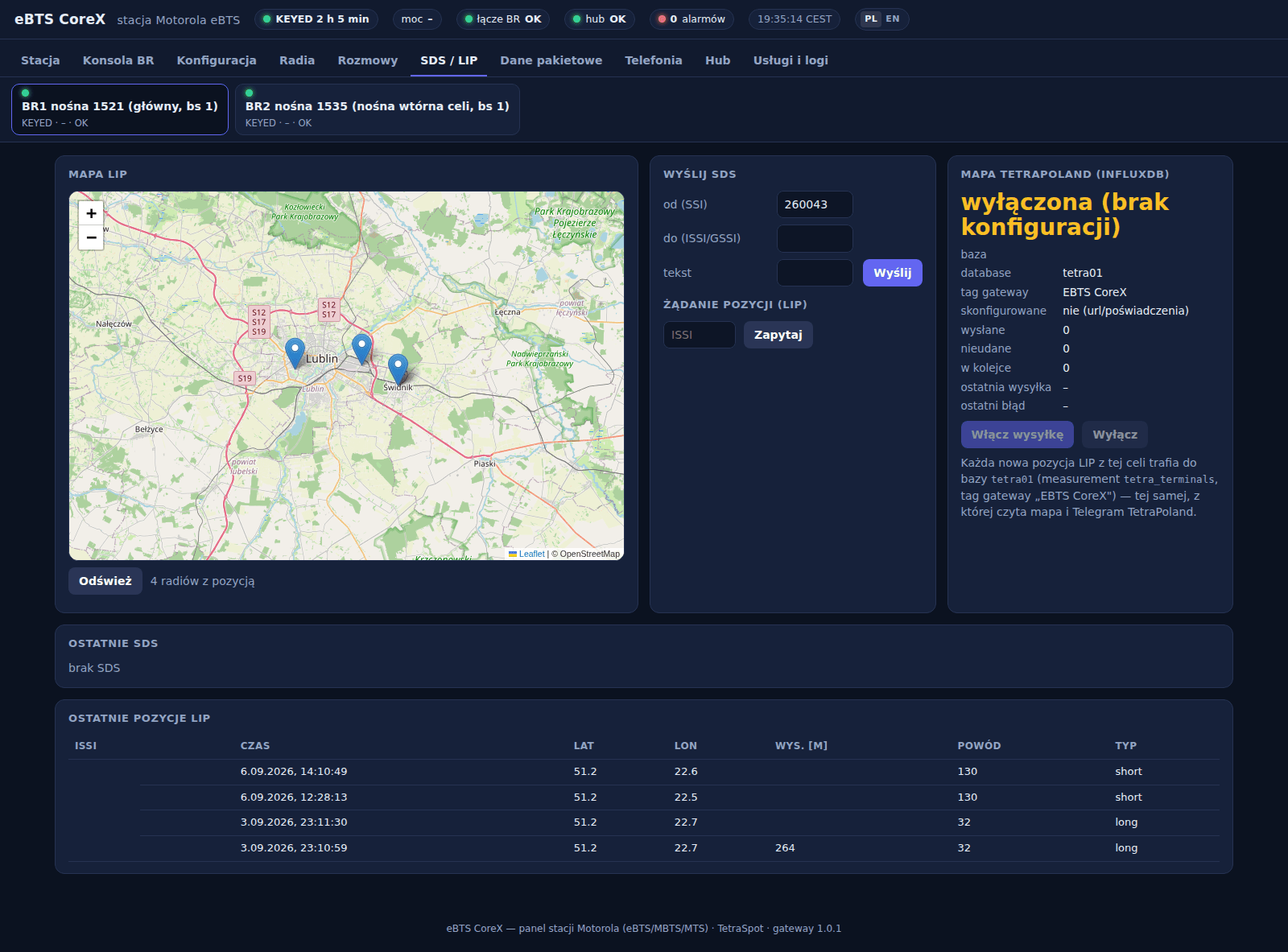
- Radio GPS positions on the map in the station panel
- Presence probing — a radio out of range is deregistered instead of lingering in the register; network time with the right time zone on the radios’ displays
- Automatic recovery after a frequency reference fault — the station dekeys and re-keys the transmitter itself
- Live BR service console with a cheat sheet of over 200 commands; power set and real output power read back
- Swapping the Base Radio for another unit without changing the configuration — the controller imposes frequencies and power
- A dedicated station web panel (eBTS CoreX), in Polish and English: both transmitters and the cell timeslots, alarms, console, configuration, radios, calls, SDS/LIP map, packet data, telephony, hub, services
In progress
- Calls on the secondary carrier — keyed and configured, but traffic only lands on it once the main carrier is full; not yet forced on the air
- Packet data with the WAP portal — the radio moves to the data channel, but keeping the channel alive on the BR side still needs to be reconstructed; work parked
- Telephony: incoming calls to a radio; BrandMeister for groups 91+; the LIP position bridge to the tetra-poland.pl map
- Periodic position reports — need changes in the radios’ codeplug
What you need
- A Motorola EBTS, MBTS or MTS station with one or two Base Radios
- An Ethernet hub with a BNC port — the station LAN runs at 10 Mb/s
- A 5 MHz frequency reference with a 1 PPS signal injected — without it the transmitter never reaches readiness
- A Linux computer with two network ports: one on the station LAN, the other to the internet